
GEO vs SEO: Who’s Running the Future of Search?
Key Takeaways
- AI is changing how people search, and is doing it faster than marketers can keep up.
- GEO doesn’t replace SEO, but it builds on it. SEO helps you get indexed. GEO helps AI choose you as the answer.
- SEO aims for top SERP positions. GEO aims to be mentioned or recommended by AI.
- Being trusted matters more than ranking first. AI favors trusted and consistent sources.
- Click rates are no longer the only success metrics. In a zero-click world, AI mentions, and citations are the new KPIs.
- SEO serves users who search, scan, and click. GEO serves users who ask questions and expect one direct answer.
- The same content appears in different places. GEO and SEO reflect different user behaviors..
- Ranking signals are different. SEO relies on keywords, backlinks, and technical setup. GEO relies on clarity, structure, citations, schema, and trust signals that AI can scan and use.
- SEO favors long, comprehensive content. GEO provides short answers to users' queries.
- The future belongs to brands that do both. SEO helps search engines find you. GEO helps AI recommend you.
We live in a world where time defines what our days will look like. People need answers fast. Businesses seek results. Marketers want more time to properly think about their next move. AI gives us the time we need. Most users now find answers through voice assistants, AI chatbots, and AI overviews that summarize information in seconds. So, the big question is:
How can you get users to see you online when they find answers without visiting your website?
In 2026, every marketer, developer, or business owner must learn to optimize for AI visibility, not just search engines. That said, GEO, as the new SEO for generative AI, is the new change to adapt to. But what is the difference between GEO vs SEO?
Let’s see how GEO and SEO are shaping the future of search, and why using both instead of choosing one is key to staying competitive.
What is SEO? Act I of Search (SEO is Still Kicking, but Less)
First place to look for something is on one of the search engines like Google, Bing, or Yahoo. When you search as a user for a product, service, company, or person, search engines show the results that best match SEO’s rules.
On the business side, SEO is how you get your site noticed by the people searching for what you offer. It helps search engines crawl and rank your pages so customers can find you.
Think of SEO as the way to build a roadmap for search engines. It will suggest different paths to users. The best results are the ones on top.
What is GEO? Act II of Search (AI’s got all the answers)
People now turn to AI platforms like ChatGPT or Claude for instant results. Instead of exploring multiple websites, users get responses in seconds. When you focus on optimizing content for LLMs, you’re working toward Generative Engine Optimization, aka GEO. The long-term goal is to become a trusted source for AI.
Think of GEO as SEO for AI. A good GEO strategy is what makes AI systems consider your brand based on trust, authority, and consistency.
GEO vs SEO Similarities: Different Practices, Same Game
GEO and SEO are like two paths that work toward one goal. Both aim at helping users to find the best answers and put their businesses in the spotlight. Skip SEO, and AI won’t even see your site to feature on its answers. Skip GEO, and your traffic can drop even if rankings look good. Here’s more on how they’re connected:
-
Same goal: Easy to find and trusted by users.
-
Type of content: High-quality, original research, stats, and real examples.
-
Structure: Headings, schema markup, metadata, lists, screenshots, images, and FAQs.
-
Trustworthy sites: Fast loading, mobile-friendly, clear format in landing pages.
-
Authority: Backlinks for SEO lead to trusted content for GEO.
-
Main focus: User intent, questions, and common search patterns.
-
Adaptation: Both need to keep up with the changes in algorithms and search behaviors.
-
Technical base: Mobile-friendly, clean code, good domain authority, no bugs.
-
Best way to boost: Cross-channel integration with social media or emails.
Key Differences Between GEO and SEO
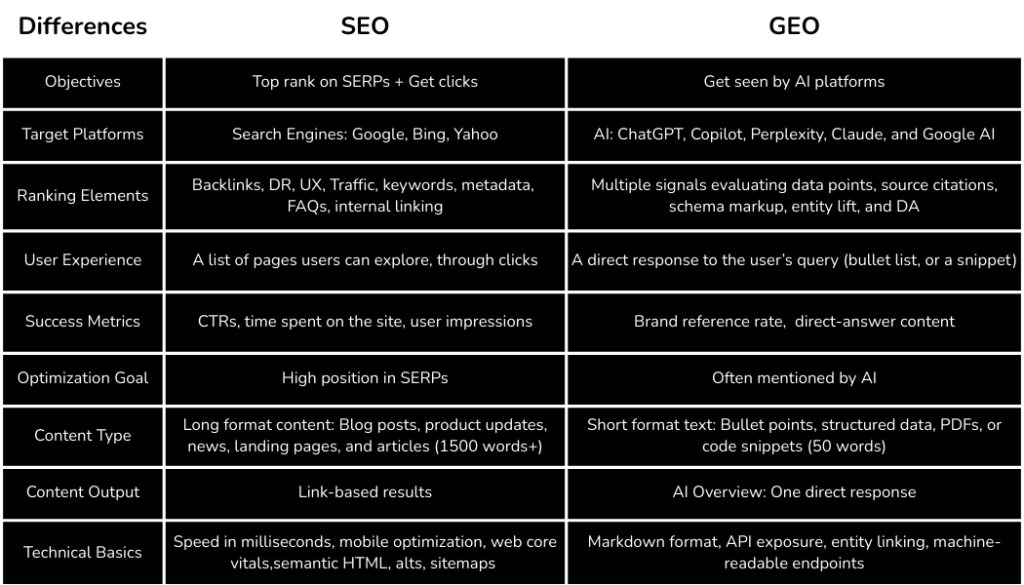
SEO and GEO do different jobs. Both matter for marketers and businesses. The real advantage comes from knowing where they differ and adapting each one to your optimization strategy.
Traditional SEO vs Conversational SEO vs GEO
Conversational SEO targets natural, spoken-style queries, mainly targeting voice search and chatbots like Siri or Alexa. Traditional SEO targets rankings on search engines online. Conversational SEO makes content sound human. GEO makes it reliable enough for AI to use it as a primary source.
The difference: Conversational SEO helps you be understood. Traditional SEO ranks you on top of SERPs. GEO helps you get selected by generative AI.
Main Objectives in Traditional SEO vs GEO
SEO is about ranking high in traditional search and driving organic clicks to your site. GEO is about showing up as an AI answer. The main goal is being mentioned, cited, or summarized, even without a click.
The difference: The goal in SEO practices is to rank high and get clicks. The goal in GEO practices is to get your business suggested by AI.
Use of Platforms
SEO-optimized content lives on your website and is built to rank on search engines like Google, Bing, and Yahoo. You can find GEO-optimized content in all sources online, including forums like Quora and Reddit.
SEO specialists focus on traditional search engines like Google, Bing, and Yahoo. GEO specialists focus on AI platforms like ChatGPT, Copilot, Perplexity, Claude, and Google’s AI features.
The difference: The same content works for both SEO and GEO, but it shows up in different places. SEO practices optimize content for search engines. GEO targets generative AI tools and crowdsourced online forums.
User Experience (Search and Expectations)
Traditional SEO is built around typed searches on engines and link-based results. Users expect a list of pages they can explore, compare, and click through. They have to open several options in different tabs, read and choose information, and move to the next website. They use keywords to search.
In GEO, the user goes from finding information to receiving it. Users use questions (long queries) to search. They expect one answer in a clear overview. AI tools respond instantly, often without showing multiple sources.
The difference: In SEO, the user experience is manual: search, scan, click, repeat. In GEO, the user expectation is just one: get the information directly from AI.
Ranking Elements for GEO and SEO
SEO ranking relies on good backlinks, domain rating, mobile optimization, metadata, FAQs, anchor text, internal links, and various keywords. The goal is to decide which pages deserve to be on top.
Instead of ranking pages, AI systems use language models to evaluate the quality of your content. GEO ranking relies on reading multiple signals as data points, authoritative source citations, schema markup, etc.
The difference: It’s easier to work directly on SEO’s ranking elements. GEO is more complex in adapting them.
Success Metrics
SEO results rise and fall with search engine algorithms, which can suddenly change. Main success metrics include click-through rates, organic traffic, backlinks growth, time spent on the site, and user impressions.
GEO results depend on how LLMs interpret the information. Instead of clicks, the focus is on AI mentions. Success metrics vary between brand trust lift, brand citation rate, and “direct-answer presence” in the content.
The difference: The main tools that measure SEO results come from search engines like Google Analytics and Search Console. GEO specialists use external tools integrated with AI platforms.
Optimization Focus
Optimizing for SEO means ranking your site pages organically. You need to signal to users that your content is relevant, so your site earns a higher position in SERPs. The higher you rank, the better the conversion rates. That means working with keywords, backlinks, domain authority, on-page, and technical SEO.
Optimizing for GEO means helping AI reuse your content. Best practices for GEO optimization include clean code, facts, stats, strong E-E-A-T, and AI-friendly formatting. Instead of backlinks, GEO relies more on citations, so AI models can trust you.
The difference: SEO optimizes with keyword rankings, while GEO optimizes for clarity. Where SEO may benefit from keywords, GEO values token efficiency.
Content Style
Content made for SEO is often long. This includes blog posts, product updates, news, landing pages, and articles. These pieces cover FAQs in the way people search. Typical length is 1500+ words.
GEO focuses on delivering precise answers within the first 50 words of the results. It supports bullet points, structured data, and formats like PDFs or snippets based on the user’s prompts.
The difference: SEO content is long text with rich metadata, images, and alt tags. GEO results are usually short texts and well-structured responses.
AI Visibility: GEO vs AEO Explained
AI tools pull information from multiple sources to answer questions. Here’s when AEO (Answer Search Optimization) comes into play to use along with GEO. Just don’t consider GEO and AEO as the same thing, because they are not.
Think of GEO and AEO as two sides of the same coin in AI visibility. AEO has a direct impact because of what users see as a response to their queries. GEO plays the long game. It takes more time to build a brand’s trust and authority on generative AI, even when users never click through.
The difference: AEO shows you as an answer to users. GEO establishes you as a trusted source for AI.
GEO vs SEO: What will happen in 2026?
GEO isn’t killing SEO. It’s building on it. Since AI and traditional search now influence each other, brands that win in 2026 will optimize for both. Here’s what we expect to come next.
1. Semantic search is the new key.
If we think about it, both SEO and GEO focus on semantic search. Both search engines and AI now focus on meaning instead of keywords. Clear, structured content is more likely to be featured and boosted on all types of search.
2. Zero-click searches will be the new norm.
More users are getting answers without clicking a single link. AI summaries and featured answers deliver what people need instantly. Visibility is shifting from traffic to presence. Soon, brands will understand they will need to optimize for AI crawlability.
3. Search journeys will get messy moving forward.
Users do not follow a linear path from A to B anymore. They may start on ChatGPT, then switch to Google. They often move between different tools before making a choice. Search is fragmented, and that’s the new normal. To stay visible, marketers need to adapt both GEO and SEO.
4. AI will power smarter marketing.
Effective marketing is AI-assisted. AI helps teams research faster, create better content, and optimize across paid channels. The advantage goes to those who use AI to make better decisions at every stage of the journey.
Optimize Everything or Fall Behind
If you want to win the game in your industry, you need to optimize everywhere you can. Experts have started to opt for a combination of GEO, SEO, and AEO. It’s a holistic, multi-platform approach that marketers need to adapt in their content strategies to stay ahead of the competition. It’s the one trend from the future that you want to be part of.